Preschool Education in Singapore: An Expat's Guide

Preschool education in Singapore covers children from about 18 months to age 6, spanning infant care, playgroup, nursery, and kindergarten. It sits before compulsory Primary 1 and marks where most children in Singapore begin their formal learning. As an expat family, stepping into the preschool scene in a new country can be quite daunting, especially in Singapore. Known for its rigorous and exceptional educational system, Singapore places a heavy emphasis on early childhood development, which is seen as essential for lifelong learning and growth. With so many top-notch options and high standards to consider, figuring out the best choice for your child can feel like a big challenge.
This guide is designed to simplify the preschool education system in Singapore, detailing what preschool in Singapore looks like at each stage, the curricula you will encounter, what the different options cost, and the questions worth asking on your school visits. Whether you're on the hunt for the best preschool fit for your child or just beginning to sift through your options, this guide will offer you valuable insights and actionable tips to help you confidently navigate the preschool education scene in Singapore.
What is Preschool Education in Singapore?
Preschool in Singapore is the umbrella term for all early childhood education from around 18 months to age 6, including infant care, playgroup, nursery, and kindergarten. It ends when a child begins Primary 1 at age 7.
Two terms often get used interchangeably but describe different provisions.
Childcare centres offer full-day care for working parents, usually with a nap period, meals, and extended hours, and they enrol children from as young as 18 months.
Kindergartens focus more narrowly on structured teaching for children aged 4 to 6, run shorter half-day sessions, and align with the year immediately before Primary 1.
Many centres offer both, which is where the confusion tends to come from.
Preschool Programmes and Ages in Singapore
Preschool in Singapore is a sequence of programmes, each roughly matched to an age band.
Infant care typically covers children from 2 to 18 months, offering care and structured play in small groups. Chatsworth International School does not offer childcare services; our early years provision begins from age 3+, offering a formal early years programme from kindergarten 1.
Playgroup or pre-nursery covers children aged 18 months to 3 years, often the first structured social setting a child experiences. Sessions are short, sensory, and play-led.
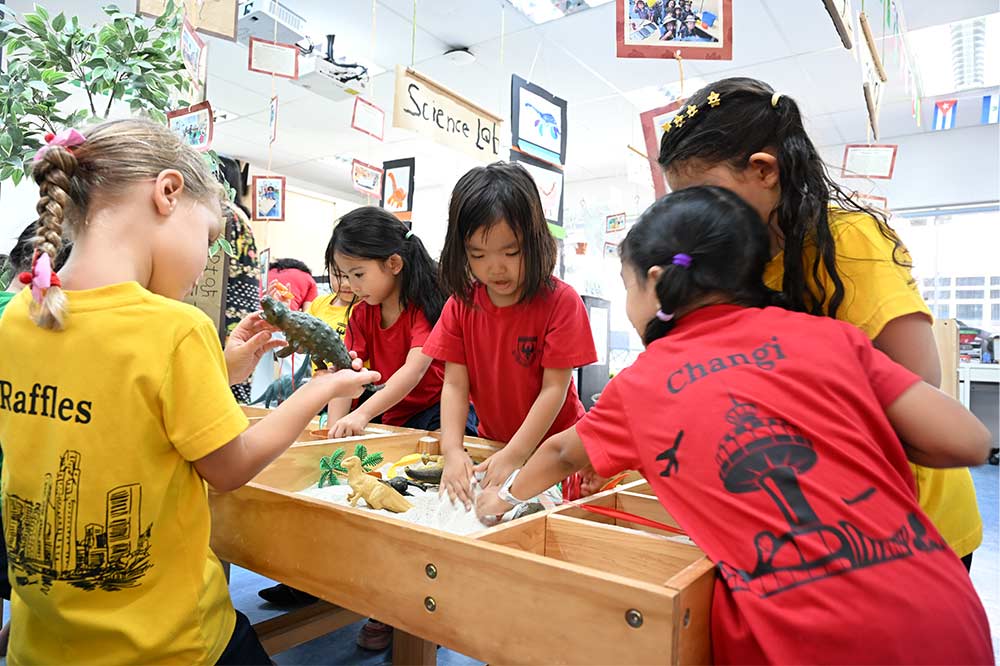
Nursery 1 and Nursery 2 cover children aged 3 to 5, where formal preschool learning begins. Children start to sit for short focused activities and are introduced to letters, numbers, and classroom routines.
Kindergarten 1 and Kindergarten 2 cover children aged 5 to 6, the year immediately before Primary 1. This is the most academically-oriented preschool age in Singapore, focused on readiness in literacy, numeracy, and social skills.
Most preschools offer both half-day sessions (typically morning, around three to four hours) and full-day enrolment (around eight to ten hours, including lunch and a nap for younger children). Working expat families usually need full-day; those with a stay-at-home parent may prefer half-day at the younger ages.
Enrolment timing matters more than most relocating families expect. Popular international kindergarten cohorts often fill six to twelve months in advance, particularly for the August intake. Begin the school search as soon as your relocation is agreed; a place on a wait pool is not the same as a confirmed place.

Understanding the Preschool Curriculum in Singapore
Before you begin narrowing down your options for preschool education in Singapore, it's crucial to understand the different curricula available and how they might suit your family's needs.
National Preschool Curriculum and Regulation
The national preschool curriculum in Singapore is structured around the Nurturing Early Learners (NEL) framework, which aims to give every child a solid start by fostering a love for learning and comprehensive development. This curriculum places a strong emphasis on character building and lifelong learning, acknowledging the crucial roles that both teachers and parents play in a child's developmental journey.
The NEL framework includes essential domains such as language and numeracy, and it enriches learning with activities in art, music, and movement. These varied educational experiences ensure that while children develop vital academic skills, they are also growing physically, emotionally, and socially.
Local preschools operating under the NEL framework are licensed and regulated by the Early Childhood Development Agency (ECDA), the statutory board that oversees the sector. ECDA also administers the Singapore Preschool Accreditation Framework (SPARK), a quality certification for ECDA-licensed local preschools that meet a defined standard.
International preschools sit outside the local licensing regime and are accredited internationally instead. Chatsworth International School is one such school and is accredited by the Western Association of Schools and Colleges (WASC), authorised as an IB World School, and holds EduTrust certification.
Reggio Emilia Approach
The Reggio Emilia Approach takes a distinctive path towards early childhood education, aiming to evoke an authentic interest in learning through child-led exploration. Based on four key principles, this approach ensures that children have a say in what they learn, engage fully with their senses, interact with peers and their surroundings, and have ample opportunities to express themselves creatively. This method fosters a dynamic and responsive learning environment where education is seen as a journey of discovery, guided by the children's natural curiosities and interactions.
Montessori Method
Renowned for preparing children for the real world, the Montessori Method offers a tailored educational experience that respects each child’s individuality and paves the way for them to develop important life skills. Focused on self-directed learning, this method allows children to choose their activities and work at their own pace within a prepared environment designed to facilitate independent exploration. This approach combines individual projects with group activities to promote social skills and cooperation.
International Baccalaureate (IB) Preschool Education
A number of international schools in Singapore, including ours, follow the IB curriculum from the earliest years. Chatsworth International School’s kindergarten programme for 3–5 year olds intentionally draws on Reggio Emilia principles, embedding them within the IB Primary Years Programme framework. This gives young learners structure, continuity, and a clear path forward as they grow.
In a preschool setting, the PYP is inquiry-led rather than lesson-led. Children spend most of their time exploring open-ended questions built around these themes:
Who we are
Where we are in place and time
How we express ourselves
How the world works
How we organise ourselves
Sharing the planet
A four-year-old might spend two weeks on how a seed becomes a plant, drawing what they observe and counting the beans they planted. Language, numeracy, science, and the arts weave through the inquiry rather than sitting as isolated subjects.
Progress in the PYP is also observed through continuous assessment rather than standardised testing. Teachers document what children can do, how they think, and where they are ready to be stretched, and share this with families through digital-learning portfolios, student-led conferences and progress reports rather than traditional letter-grade report cards.
International Preschool vs Local Preschool: What’s the Difference?
An international preschool differs from a local one in three practical ways.
The curriculum is typically drawn from an international framework such as the IB Primary Years Programme, a British Early Years Foundation Stage, or an American programme, rather than Singapore's NEL.
The cohort is deliberately international, with children from different nationalities in the same classroom and English as the shared language of instruction.
The school is built to feed into an international primary and secondary programme within the same institution, so the transition into Year 1 is seamless rather than a fresh admissions round in a new school.
For families who expect to move again, or who want their child educated in the same framework they will encounter in their next country, an international preschool is usually the more practical starting point. You can read more about our own early years provision on our international kindergarten and preschool page.
How Much Does Preschool Cost in Singapore?
Preschool costs in Singapore vary dramatically by school type, ranging from around S$160 a month at the most affordable end to more than S$3,800 per month at the premium international end. Local and international provision are essentially separate markets, and comparing them like-for-like can mislead.
The table below gives indicative annual fee ranges for the 2026-27 academic year across the main preschool categories.
Type of preschool | Indicative annual fees (2026-27) |
MOE Kindergarten (Singapore Citizens) | S$1,920 |
MOE Kindergarten (Permanent Residents) | S$3,840 |
Local private preschools | S$10,000 to S$25,000 |
Mid-range international preschools | S$20,000 to S$35,000 |
Premium international preschools | S$30,000 to S$45,000+ |
Figures compiled from published school fees and current market summaries, September 2026. Individual schools vary significantly within each band.
Sources: Ministry of Education for MOE Kindergarten monthly fees; The International Schools for private and international preschool bands; Skoolopedia for additional fee categories.
A few practical notes before you budget from that table. Government childcare subsidies are limited to Singapore Citizen children and only apply at ECDA-licensed local preschools; as an expat family holding a foreign passport, you will pay the full published fees wherever you enrol.
Published tuition is also rarely the total cost. Most preschools charge a one-time registration or confirmation fee (typically S$300 to S$3,500), an annual development or capital fee (often S$1,000 to S$5,000), plus uniforms, materials, and meals if not included. International schools may also charge for English as an Additional Language (EAL) or Learning Support where required. Ask any prospective school for a full first-year cost estimate rather than the headline tuition figure; the two can differ by several thousand dollars.
For reference, our own 2026-27 Kindergarten 1 and Kindergarten 2 fees at Chatsworth International School are S$30,554 per year, with a S$325 application fee and a S$3,250 one-time confirmation fee upon offer of a place. Find out more about international school fees in Singapore.
Choosing the Right Preschool for Your Little One
Location and daily commute. A twenty-minute door-to-door commute and a fifty-minute one are very different experiences for a four-year-old. Consider where you will actually live and whether the school runs a bus to your district.
Class size and adult-to-child ratio. ECDA minimums are a floor, not a target. Ask what the actual ratio is at your child's age band and how many adults are in the room during the busiest parts of the day.
Curriculum fit for your family. A play-based inquiry programme, a Montessori environment, and a more structured Reggio setting each suit different children. Watch a classroom in session if the school allows it; half an hour of observation tells you more than a brochure.
Language exposure. Most international preschools teach in English with a second-language strand, often Mandarin. If bilingualism matters to you, ask specifically how the second language is taught, how often, and by whom.
What you notice on the visit. How does the head of school greet the children in the hallway? How do the children behave when a teacher is not directly supervising them? These small signals reveal more about the diversity of the school's environment than a prospectus can.
For relocating families, mid-year admission and transferability. A curriculum used only in Singapore leaves your child starting over in the next country; an internationally recognised framework such as the IB, EYFS, or an American programme travels with them. If you arrive in October rather than August, ask specifically about pastoral support in the first four to six weeks and what parents can expect to hear from teachers during that period.
None of these criteria settles the question on their own. Together, they give you a sharper set of questions to bring to each preschool you consider, and a better sense of what to watch for once you are inside the building. If Chatsworth International School is on your list, book a campus tour, and we would be glad to show you around.